Welcome to the second part in the "Bible According to Caravaggio" series. I have no idea how many parts there will be, but if there are more to come I promise that they will not be almost a year apart like this one is. For those of you who missed the first part, you can find it
here. Oddly enough the first post on Caravaggio has been my most read post. Who knew a color-blind guy posing as an art critic could garner so much attention.
Without further procrastination, let's take a look at a few more of Caravaggio's paintings concerning biblical subjects and find out if he really does capture each scene accurately.
The Martyrdom of Saint Matthew

This is another case of not having a biblical record to support or deny the accuracy of this painting. In fact, according to the Catholic church, any information we have of Matthew's death is "nothing but legend". Regardless, Caravaggio sets out to show the joy of being martyred for Christ, and this is exactly the disposition we find in both Eusebius' History of the Church and John Foxe's Book of Martyrs. Here is the Wikipedia explanation of this painting:
"The painting shows the martyrdom of Saint Matthew the Evangelist, author of the Gospel of Matthew. According to tradition, the saint was killed on the orders of the king of Ethiopia while celebrating Mass at the altar. The king lusted after his own niece, and had been rebuked by Matthew, for the girl was a nun, and therefore the bride of Christ. Cardinal Contarelli, who had died several decades earlier, had laid down very explicitly what was to be shown: the saint being murdered by a soldier sent by the wicked king, some suitable architecture, and crowds of onlookers showing appropriate emotion....It takes concentration to understand that the confused melee is a victory of sainthood. Saint Matthew appears to recoil as he falls before the naked fury of his executioner, burning in the glare of light, who readies his sword to strike. Around the saint are persons showing varied emotions, as required by Contarelli: terror, awe, and consternation, while an angel holds out the palm of martyrdom. Confusion about the image can be alleviated by understanding that Matthew is not quailing in fear at the executioner's strike, instead he reaches for the angel's gift. The executioner's grasp and the angel's reach are two parallel paths. Only Matthew is privy to the angelic visitation. Viewed as such, this is a painting not about a moment of general terror, but the death of a saint as the personal handshake of the divine. Italian Baroque painting and sculpture of the time commonly depicted martyrdoms not as moments of fear, but as moments of joy or ecstasy,"The Calling of St Matthew

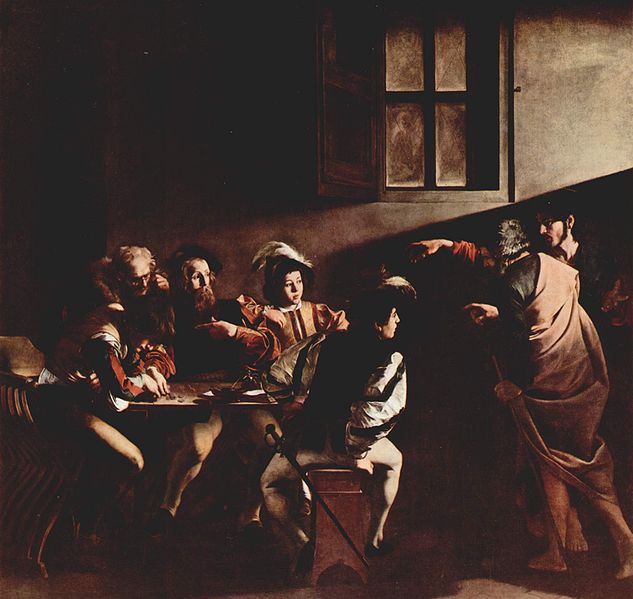
This is the companion piece to
The Martyrdom of Saint Matthew commissioned by Cardinal Contarelli. This work is based off of the biblical text of Matthew 9:9:
As Jesus passed on from there, he saw a man called Matthew sitting at the tax booth, and he said to him, “Follow me.” And he rose and followed him.Obviously, the clothing is not historically accurate for the period. It may be accurate to Caravaggio's time, but not during the time of Christ. I never imagined the tax booth to be indoors either, but I suppose it could have been possible. What is fascinating is the look of Jesus' pointing hand. The similarity to Michaelangelo's familiar painting of God's outstretched arm to Adam in the Sistine Chapel is undeniable. The image of Levi on the far left with his face woeful and buried in collected taxes while Jesus commands him to follow is accurate in depicting the darkness that is prevalent without Christ. This painting appears to resemble the passage quite clearly, but I'm not sure I agree with some of Caravaggio's choices.
(
I will post part three shortly...I promise)