Showing posts with label Art. Show all posts
Showing posts with label Art. Show all posts
Wednesday, August 19, 2009
While My "Ukelele" Gently Weeps
Another video. In my defense, this is simply beautiful and should be shared.


Thursday, March 5, 2009
The Bible According to Caravaggio - Part 2
Welcome to the second part in the "Bible According to Caravaggio" series. I have no idea how many parts there will be, but if there are more to come I promise that they will not be almost a year apart like this one is. For those of you who missed the first part, you can find it here. Oddly enough the first post on Caravaggio has been my most read post. Who knew a color-blind guy posing as an art critic could garner so much attention.
Without further procrastination, let's take a look at a few more of Caravaggio's paintings concerning biblical subjects and find out if he really does capture each scene accurately.
This is another case of not having a biblical record to support or deny the accuracy of this painting. In fact, according to the Catholic church, any information we have of Matthew's death is "nothing but legend". Regardless, Caravaggio sets out to show the joy of being martyred for Christ, and this is exactly the disposition we find in both Eusebius' History of the Church and John Foxe's Book of Martyrs. Here is the Wikipedia explanation of this painting:
"The painting shows the martyrdom of Saint Matthew the Evangelist, author of the Gospel of Matthew. According to tradition, the saint was killed on the orders of the king of Ethiopia while celebrating Mass at the altar. The king lusted after his own niece, and had been rebuked by Matthew, for the girl was a nun, and therefore the bride of Christ. Cardinal Contarelli, who had died several decades earlier, had laid down very explicitly what was to be shown: the saint being murdered by a soldier sent by the wicked king, some suitable architecture, and crowds of onlookers showing appropriate emotion....It takes concentration to understand that the confused melee is a victory of sainthood. Saint Matthew appears to recoil as he falls before the naked fury of his executioner, burning in the glare of light, who readies his sword to strike. Around the saint are persons showing varied emotions, as required by Contarelli: terror, awe, and consternation, while an angel holds out the palm of martyrdom. Confusion about the image can be alleviated by understanding that Matthew is not quailing in fear at the executioner's strike, instead he reaches for the angel's gift. The executioner's grasp and the angel's reach are two parallel paths. Only Matthew is privy to the angelic visitation. Viewed as such, this is a painting not about a moment of general terror, but the death of a saint as the personal handshake of the divine. Italian Baroque painting and sculpture of the time commonly depicted martyrdoms not as moments of fear, but as moments of joy or ecstasy,"
This is the companion piece to The Martyrdom of Saint Matthew commissioned by Cardinal Contarelli. This work is based off of the biblical text of Matthew 9:9:
As Jesus passed on from there, he saw a man called Matthew sitting at the tax booth, and he said to him, “Follow me.” And he rose and followed him.
Obviously, the clothing is not historically accurate for the period. It may be accurate to Caravaggio's time, but not during the time of Christ. I never imagined the tax booth to be indoors either, but I suppose it could have been possible. What is fascinating is the look of Jesus' pointing hand. The similarity to Michaelangelo's familiar painting of God's outstretched arm to Adam in the Sistine Chapel is undeniable. The image of Levi on the far left with his face woeful and buried in collected taxes while Jesus commands him to follow is accurate in depicting the darkness that is prevalent without Christ. This painting appears to resemble the passage quite clearly, but I'm not sure I agree with some of Caravaggio's choices.
(I will post part three shortly...I promise)
Without further procrastination, let's take a look at a few more of Caravaggio's paintings concerning biblical subjects and find out if he really does capture each scene accurately.
The Martyrdom of Saint Matthew

This is another case of not having a biblical record to support or deny the accuracy of this painting. In fact, according to the Catholic church, any information we have of Matthew's death is "nothing but legend". Regardless, Caravaggio sets out to show the joy of being martyred for Christ, and this is exactly the disposition we find in both Eusebius' History of the Church and John Foxe's Book of Martyrs. Here is the Wikipedia explanation of this painting:
"The painting shows the martyrdom of Saint Matthew the Evangelist, author of the Gospel of Matthew. According to tradition, the saint was killed on the orders of the king of Ethiopia while celebrating Mass at the altar. The king lusted after his own niece, and had been rebuked by Matthew, for the girl was a nun, and therefore the bride of Christ. Cardinal Contarelli, who had died several decades earlier, had laid down very explicitly what was to be shown: the saint being murdered by a soldier sent by the wicked king, some suitable architecture, and crowds of onlookers showing appropriate emotion....It takes concentration to understand that the confused melee is a victory of sainthood. Saint Matthew appears to recoil as he falls before the naked fury of his executioner, burning in the glare of light, who readies his sword to strike. Around the saint are persons showing varied emotions, as required by Contarelli: terror, awe, and consternation, while an angel holds out the palm of martyrdom. Confusion about the image can be alleviated by understanding that Matthew is not quailing in fear at the executioner's strike, instead he reaches for the angel's gift. The executioner's grasp and the angel's reach are two parallel paths. Only Matthew is privy to the angelic visitation. Viewed as such, this is a painting not about a moment of general terror, but the death of a saint as the personal handshake of the divine. Italian Baroque painting and sculpture of the time commonly depicted martyrdoms not as moments of fear, but as moments of joy or ecstasy,"
The Calling of St Matthew
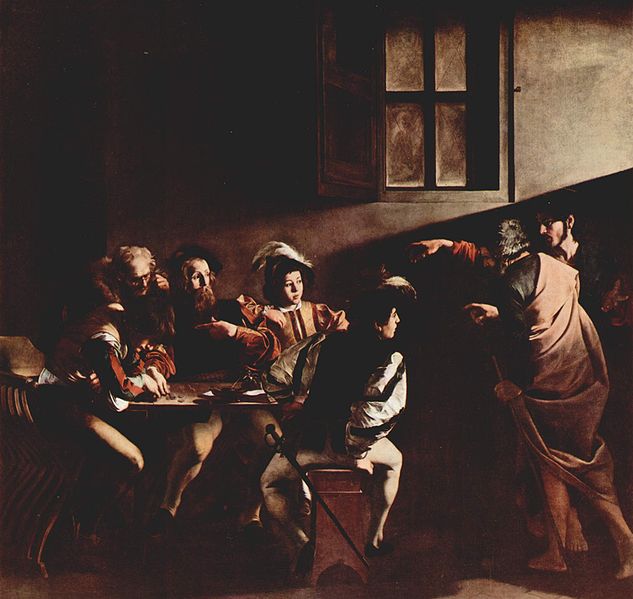
This is the companion piece to The Martyrdom of Saint Matthew commissioned by Cardinal Contarelli. This work is based off of the biblical text of Matthew 9:9:
Obviously, the clothing is not historically accurate for the period. It may be accurate to Caravaggio's time, but not during the time of Christ. I never imagined the tax booth to be indoors either, but I suppose it could have been possible. What is fascinating is the look of Jesus' pointing hand. The similarity to Michaelangelo's familiar painting of God's outstretched arm to Adam in the Sistine Chapel is undeniable. The image of Levi on the far left with his face woeful and buried in collected taxes while Jesus commands him to follow is accurate in depicting the darkness that is prevalent without Christ. This painting appears to resemble the passage quite clearly, but I'm not sure I agree with some of Caravaggio's choices.
(I will post part three shortly...I promise)
Tuesday, February 24, 2009
Tuesday, September 23, 2008
Thursday, September 18, 2008
Why singing will be in Heaven...
Outside of various scriptural references of course.
O Magnum Mysterium composed by Morten Lauridsen
I had the privilege of singing this in college, and every time I hear it I find myself in a state of reverence. Simply beautiful. Here are the lyrics with translation.
Latin text
O magnum mysterium,
et admirabile sacramentum,
ut animalia viderent Dominum natum,
jacentem in praesepio!
Beata Virgo, cujus viscera
meruerunt portare
Dominum Christum.
Alleluia.
English translation
O great mystery,
and wonderful sacrament,
that animals should see the new-born Lord,
lying in a manger!
Blessed is the Virgin whose womb
was worthy to bear
Christ the Lord.
Alleluia!
O Magnum Mysterium composed by Morten Lauridsen
I had the privilege of singing this in college, and every time I hear it I find myself in a state of reverence. Simply beautiful. Here are the lyrics with translation.
Latin text
O magnum mysterium,
et admirabile sacramentum,
ut animalia viderent Dominum natum,
jacentem in praesepio!
Beata Virgo, cujus viscera
meruerunt portare
Dominum Christum.
Alleluia.
English translation
O great mystery,
and wonderful sacrament,
that animals should see the new-born Lord,
lying in a manger!
Blessed is the Virgin whose womb
was worthy to bear
Christ the Lord.
Alleluia!
Wednesday, September 17, 2008
Wednesday, August 20, 2008
LeRoi Moore of Dave Matthews Band Dies at 46
 During high school and my early college years there was only one band that I listened to. Dave Matthews Band.
 DMB was a very prominent idol in my life during that time, and as a result I knew every sax and flute solo that LeRoi Moore ever played.
I haven't listened to DMB in some time, but this still came as a shock to me. I have no doubt that he will be missed by not only the members of the band, but also by millions of loyal fans across the globe. Here is the official statement from DMB's website:
We are deeply saddened that LeRoi Moore, saxophonist and founding member of Dave Matthews Band, died unexpectedly Tuesday afternoon, August 19, 2008, at Hollywood Presbyterian Medical Center in Los Angeles from sudden complications stemming from his June ATV accident on his farm near Charlottesville, Virginia. LeRoi had recently returned to his Los Angeles home to begin an intensive physical rehabilitation program.
Thursday, June 19, 2008
Tuesday, May 20, 2008
Augustine on the Theatre, Compassion, & Grief
Book 3: Chapter 2
2. Stage plays also captivated me, with their sights full of the images of my own miseries: fuel for my own fire. Now, why does a man like to be made sad by viewing doleful and tragic scenes, which he himself could not by any means endure? Yet, as a spectator, he wishes to experience from them a sense of grief, and in this very sense of grief his pleasure consists. What is this but wretched madness? For a man is more affected by these actions the more he is spuriously involved in these affections. Now, if he should suffer them in his own person, it is the custom to call this "misery." But when he suffers with another, then it is called "compassion." But what kind of compassion is it that arises from viewing fictitious and unreal sufferings? The spectator is not expected to aid the sufferer but merely to grieve for him. And the more he grieves the more he applauds the actor of these fictions. If the misfortunes of the characters -- whether historical or entirely imaginary -- are represented so as not to touch the feelings of the spectator, he goes away disgusted and complaining. But if his feelings are deeply touched, he sits it out attentively, and sheds tears of joy.
3. Tears and sorrow, then, are loved. Surely every man desires to be joyful. And, though no one is willingly miserable, one may, nevertheless, be pleased to be merciful so that we love their sorrows because without them we should have nothing to pity. This also springs from that same vein of friendship. But whither does it go? Whither does it flow? Why does it run into that torrent of pitch which seethes forth those huge tides of loathsome lusts in which it is changed and altered past recognition, being diverted and corrupted from its celestial purity by its own will? Shall, then, compassion be repudiated? By no means! Let us, however, love the sorrows of others. But let us beware of uncleanness, O my soul, under the protection of my God, the God of our fathers, who is to be praised and exalted -- let us beware of uncleanness. I have not yet ceased to have compassion. But in those days in the theaters I sympathized with lovers when they sinfully enjoyed one another, although this was done fictitiously in the play. And when they lost one another, I grieved with them, as if pitying them, and yet had delight in both grief and pity. Nowadays I feel much more pity for one who delights in his wickedness than for one who counts himself unfortunate because he fails to obtain some harmful pleasure or suffers the loss of some miserable felicity. This, surely, is the truer compassion, but the sorrow I feel in it has no delight for me. For although he that grieves with the unhappy should be commended for his work of love, yet he who has the power of real compassion would still prefer that there be nothing for him to grieve about. For if good will were to be ill will -- which it cannot be -- only then could he who is truly and sincerely compassionate wish that there were some unhappy people so that he might commiserate them. Some grief may then be justified, but none of it loved. Thus it is that thou dost act, O Lord God, for thou lovest souls far more purely than we do and art more incorruptibly compassionate, although thou art never wounded by any sorrow. Now "who is sufficient for these things?"[59]
4. But at that time, in my wretchedness, I loved to grieve; and I sought for things to grieve about. In another man's misery, even though it was feigned and impersonated on the stage, that performance of the actor pleased me best and attracted me most powerfully which moved me to tears. What marvel then was it that an unhappy sheep, straying from thy flock and impatient of thy care, I became infected with a foul disease? This is the reason for my love of griefs: that they would not probe into me too deeply (for I did not love to suffer in myself such things as I loved to look at), and they were the sort of grief which came from hearing those fictions, which affected only the surface of my emotion. Still, just as if they had been poisoned fingernails, their scratching was followed by inflammation, swelling, putrefaction, and corruption. Such was my life! But was it life, O my God?
Monday, May 19, 2008
The Bible According to Caravaggio - Part 1
I am no art scholar. To be honest, I'm partially colorblind which pretty much disqualifies me from interpreting the use of color, or even lighting for that matter. In fact, when I was in middle school I actually failed the color wheel. My art teacher had no sympathy for me whatsoever and actually failed me. Seriously now, who does that?
Regardless of my inability to see color, I do know what I like, and I just can't get enough of the art of Michelangelo Merisi da Caravaggio. Here is some background information from Wikipedia:
Michelangelo Merisi da Caravaggio (September 28, 1571 – 18 July 1610) was an Italian artist active in Rome, Naples, Malta and Sicily between 1593 and 1610. He is commonly placed in the Baroque school, of which he was the first great representative...Huge new churches and palazzi were being built in Rome in the decades of the late 16th and early 17th centuries, and paintings were needed to fill them. The Counter-Reformation Church searched for authentic religious art with which to counter the threat of Protestantism, and for this task the artificial conventions of Mannerism, which had ruled art for almost a century, no longer seemed adequate. Caravaggio's novelty was a radical naturalism which combined close physical observation with a dramatic, even theatrical, approach to chiaroscuro, the use of light and shadow.
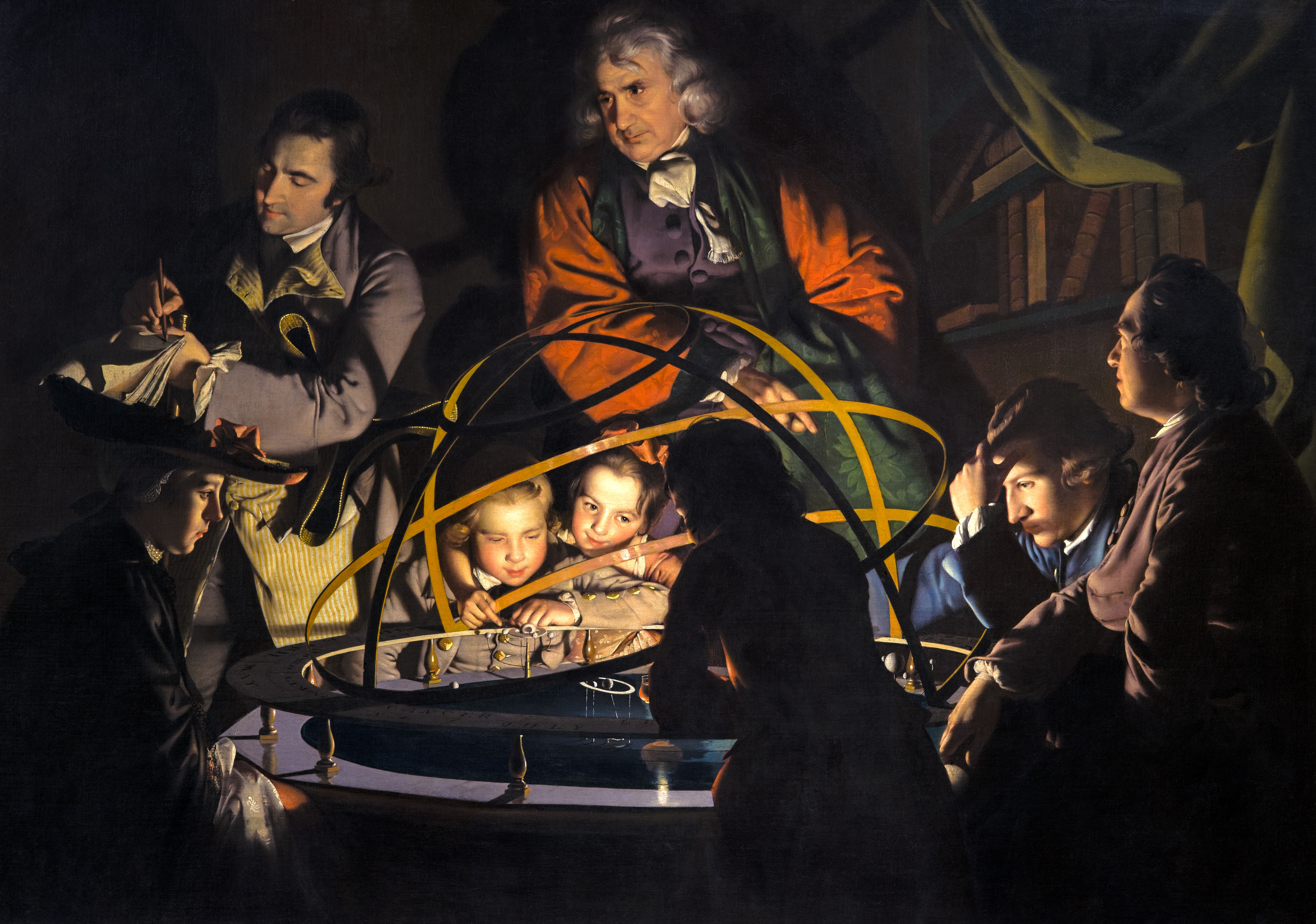
For reference, the first painting below is known as Mannerism, and the second is Naturalism with the use of Chiaroscuro:
What draws me to the art of Caravaggio is the atmosphere that he is able to create, and the story that he tells so richly from just one moment in time. I wanted to use this post to look into his take on biblical subjects, not only to appreciate his ability, but also to see if he really does capture each scene correctly.
Well, we really don't have a biblical record of Peter being crucified upside-down. However, we do have a reference to his death from Eusebius' Ecclesiastical History which states, "Peter appears to have preached through Pontus, Galatia, Bithynia, Cappadocia, and Asia, to the Jews that were scattered abroad; who also, finally coming to Rome, was crucified with his head downward, having requested of himself to suffer in this way" (Ecclesiastical History 3:1). Regardless, this is an incredible piece of art.
The story of Martha and Mary is taken from Luke 10:38-42:
Now as they went on their way, Jesus entered a village. And a woman named Martha welcomed him into her house. And she had a sister called Mary, who sat at the Lord's feet and listened to his teaching. But Martha was distracted with much serving. And she went up to him and said, “Lord, do you not care that my sister has left me to serve alone? Tell her then to help me.” But the Lord answered her, “Martha, Martha, you are anxious and troubled about many things, but one thing is necessary. Mary has chosen the good portion, which will not be taken away from her.”
I don't think that Caravaggio captured this very well at all. In fact, being the ignorant art lover that I am, I didn't see the connection at all. However, I found this explanation on Wikipedia that partially cleared things up:
The painting shows the Biblical sisters Martha and Mary Magdalene - Martha is in the act of converting Mary from her life of pleasure to the life of virtue in Christ. Martha, her face shadowed, leans forward, passionately arguing with Mary, who twirls an orange blossom between her fingers as she holds a mirror, symbolising the vanity she is about to give up. The power of the image lies in Mary's face, caught at the moment when conversion begins.
I'll let you be the judge of this one, but I find it to be a little bit of a departure from the biblical text.
Here is the biblical reference, Genesis 22:9-13:
When they came to the place of which God had told him, Abraham built the altar there and laid the wood in order and bound Isaac his son and laid him on the altar, on top of the wood. Then Abraham reached out his hand and took the knife to slaughter his son. But the angel of the Lord called to him from heaven and said, “Abraham, Abraham!” And he said, “Here am I.” He said, “Do not lay your hand on the boy or do anything to him, for now I know that you fear God, seeing you have not withheld your son, your only son, from me.” And Abraham lifted up his eyes and looked, and behold, behind him was a ram, caught in a thicket by his horns. And Abraham went and took the ram and offered it up as a burnt offering instead of his son.
I really like this one. I am not going to lie. Everything appears to be there: Abraham, Isaac, the altar, an angel, the ram, the knife. The houses in the background seem a little out of place and a little modern (for the time). The angel also has the typical "youthful" look that is common in most art, yet I doubt heavenly angels really look like that. They are probably a little more intimidating.
Let's look at one more today.
So here we have Mary, Joseph, Jesus, and a half naked angel playing the violin. Let's see what Matthew 2:13-15 says:
Now when they had departed, behold, an angel of the Lord appeared to Joseph in a dream and said, “Rise, take the child and his mother, and flee to Egypt, and remain there until I tell you, for Herod is about to search for the child, to destroy him.” And he rose and took the child and his mother by night and departed to Egypt and remained there until the death of Herod. This was to fulfill what the Lord had spoken by the prophet, “Out of Egypt I called my son.”
Right. Good thing Joseph is holding the angel's music or this would be totally inaccurate...At this point you are all wondering why I like Caravaggio so much when he gets so many things wrong. Well, I didn't say I appreciated ALL of his art, and some of the best paintings are yet to come.
Caravaggio's ability with a brush is impressive, but I think we can all see that textual accuracy was not the priority. Things do get better, I promise. Until next time...
Regardless of my inability to see color, I do know what I like, and I just can't get enough of the art of Michelangelo Merisi da Caravaggio. Here is some background information from Wikipedia:
Michelangelo Merisi da Caravaggio (September 28, 1571 – 18 July 1610) was an Italian artist active in Rome, Naples, Malta and Sicily between 1593 and 1610. He is commonly placed in the Baroque school, of which he was the first great representative...Huge new churches and palazzi were being built in Rome in the decades of the late 16th and early 17th centuries, and paintings were needed to fill them. The Counter-Reformation Church searched for authentic religious art with which to counter the threat of Protestantism, and for this task the artificial conventions of Mannerism, which had ruled art for almost a century, no longer seemed adequate. Caravaggio's novelty was a radical naturalism which combined close physical observation with a dramatic, even theatrical, approach to chiaroscuro, the use of light and shadow.
For reference, the first painting below is known as Mannerism, and the second is Naturalism with the use of Chiaroscuro:
Rosso Fiorentino: Moses Defending the Daughters of Jethro
Joseph Wright of Derby: A Philosopher Giving that Lecture on the Orrery, in which a Lamp is put in place of the Sun

What draws me to the art of Caravaggio is the atmosphere that he is able to create, and the story that he tells so richly from just one moment in time. I wanted to use this post to look into his take on biblical subjects, not only to appreciate his ability, but also to see if he really does capture each scene correctly.
Crucifixion of St. Peter
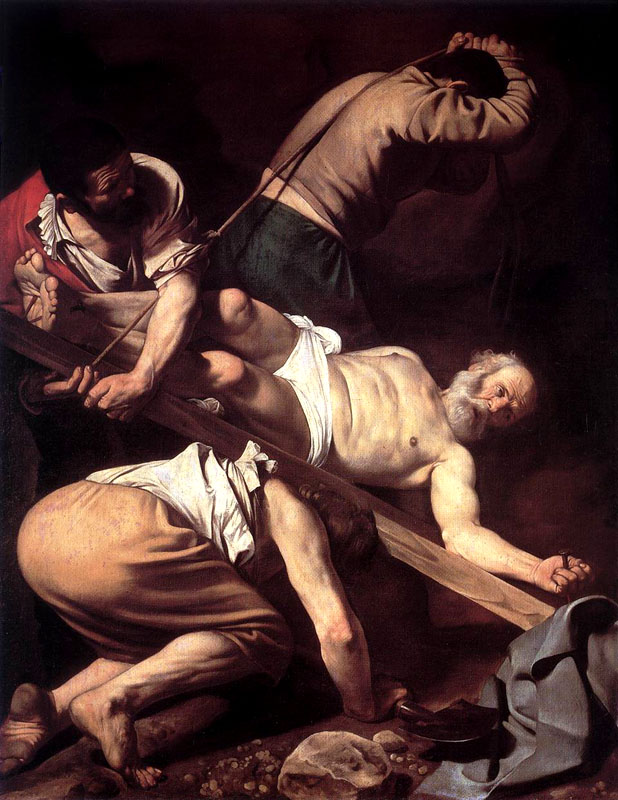
Well, we really don't have a biblical record of Peter being crucified upside-down. However, we do have a reference to his death from Eusebius' Ecclesiastical History which states, "Peter appears to have preached through Pontus, Galatia, Bithynia, Cappadocia, and Asia, to the Jews that were scattered abroad; who also, finally coming to Rome, was crucified with his head downward, having requested of himself to suffer in this way" (Ecclesiastical History 3:1). Regardless, this is an incredible piece of art.
Martha and Mary

The story of Martha and Mary is taken from Luke 10:38-42:
Now as they went on their way, Jesus entered a village. And a woman named Martha welcomed him into her house. And she had a sister called Mary, who sat at the Lord's feet and listened to his teaching. But Martha was distracted with much serving. And she went up to him and said, “Lord, do you not care that my sister has left me to serve alone? Tell her then to help me.” But the Lord answered her, “Martha, Martha, you are anxious and troubled about many things, but one thing is necessary. Mary has chosen the good portion, which will not be taken away from her.”
I don't think that Caravaggio captured this very well at all. In fact, being the ignorant art lover that I am, I didn't see the connection at all. However, I found this explanation on Wikipedia that partially cleared things up:
The painting shows the Biblical sisters Martha and Mary Magdalene - Martha is in the act of converting Mary from her life of pleasure to the life of virtue in Christ. Martha, her face shadowed, leans forward, passionately arguing with Mary, who twirls an orange blossom between her fingers as she holds a mirror, symbolising the vanity she is about to give up. The power of the image lies in Mary's face, caught at the moment when conversion begins.
I'll let you be the judge of this one, but I find it to be a little bit of a departure from the biblical text.
The Sacrifice of Isaac

Here is the biblical reference, Genesis 22:9-13:
When they came to the place of which God had told him, Abraham built the altar there and laid the wood in order and bound Isaac his son and laid him on the altar, on top of the wood. Then Abraham reached out his hand and took the knife to slaughter his son. But the angel of the Lord called to him from heaven and said, “Abraham, Abraham!” And he said, “Here am I.” He said, “Do not lay your hand on the boy or do anything to him, for now I know that you fear God, seeing you have not withheld your son, your only son, from me.” And Abraham lifted up his eyes and looked, and behold, behind him was a ram, caught in a thicket by his horns. And Abraham went and took the ram and offered it up as a burnt offering instead of his son.
I really like this one. I am not going to lie. Everything appears to be there: Abraham, Isaac, the altar, an angel, the ram, the knife. The houses in the background seem a little out of place and a little modern (for the time). The angel also has the typical "youthful" look that is common in most art, yet I doubt heavenly angels really look like that. They are probably a little more intimidating.
Let's look at one more today.
Rest on the Flight into Egypt
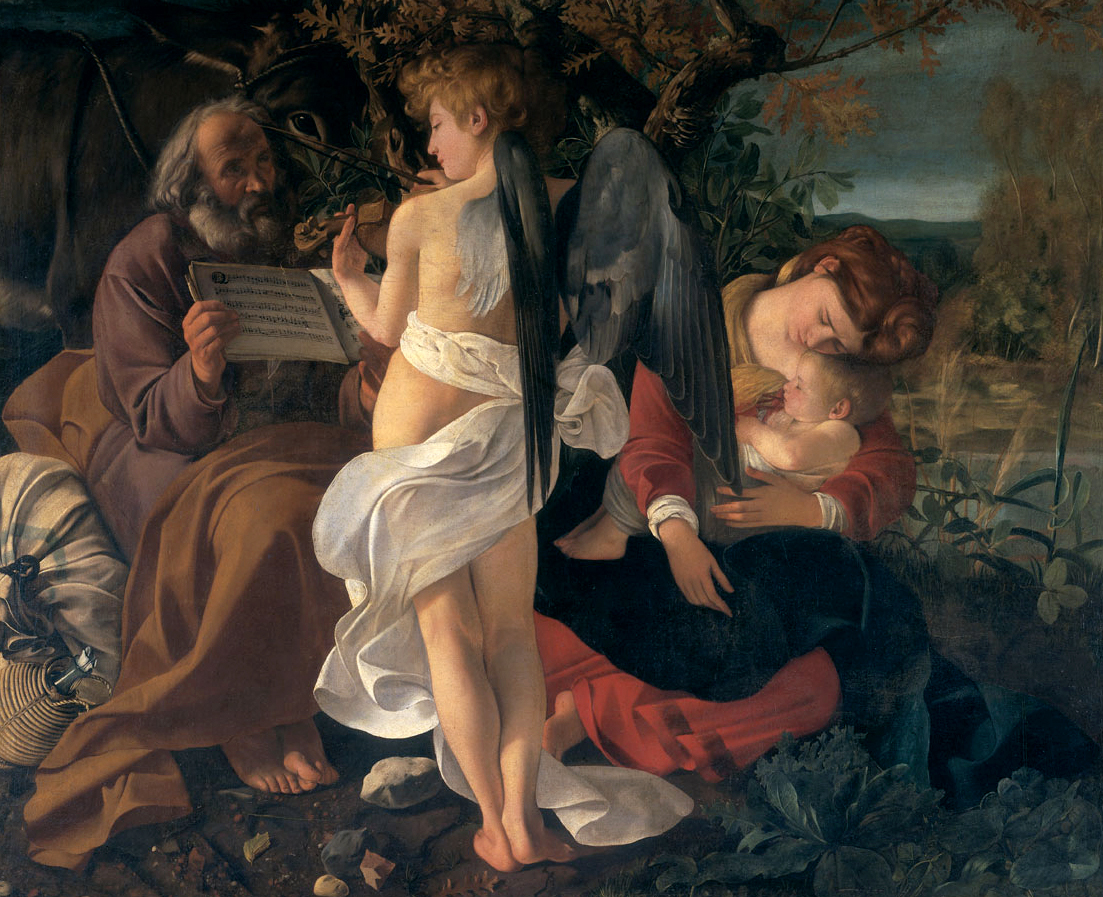
So here we have Mary, Joseph, Jesus, and a half naked angel playing the violin. Let's see what Matthew 2:13-15 says:
Now when they had departed, behold, an angel of the Lord appeared to Joseph in a dream and said, “Rise, take the child and his mother, and flee to Egypt, and remain there until I tell you, for Herod is about to search for the child, to destroy him.” And he rose and took the child and his mother by night and departed to Egypt and remained there until the death of Herod. This was to fulfill what the Lord had spoken by the prophet, “Out of Egypt I called my son.”
Right. Good thing Joseph is holding the angel's music or this would be totally inaccurate...At this point you are all wondering why I like Caravaggio so much when he gets so many things wrong. Well, I didn't say I appreciated ALL of his art, and some of the best paintings are yet to come.
Caravaggio's ability with a brush is impressive, but I think we can all see that textual accuracy was not the priority. Things do get better, I promise. Until next time...
Friday, March 28, 2008
The Beauty of God's Creation
I often marvel at the beauty and detail that exists in creation. I have been studying the creation account in Genesis 1 and I cannot tell you how often I set my Bible down and simply reflect on the unimaginable power of God. It leaves me absolutely speechless, and I often find myself in a state of confusion and awe. To dwell on the fact that God created all that we see, smell, hear, see and touch with His words alone, or as John Piper puts it, "with the flick of His little finger" should really bring all of us to our knees. What a great Creator we have, and how marvelous is His creation!
What is incredible is how little I understand about God's creation. I knew that the detail He showed when creating the animals was far beyond human possibility, and I also know that humans carry the same desire to create that God has. However, I had no idea that this creative impulse existed with such an artistic degree amidst the animals as well. To understand what I am talking about, please view the clip below.
What is incredible is how little I understand about God's creation. I knew that the detail He showed when creating the animals was far beyond human possibility, and I also know that humans carry the same desire to create that God has. However, I had no idea that this creative impulse existed with such an artistic degree amidst the animals as well. To understand what I am talking about, please view the clip below.
Subscribe to:
Posts (Atom)